Australian Geometric Analysis and PDE Workshop at UOW
Second workshop in the Australian Geometric Analysis and PDE workshop series.
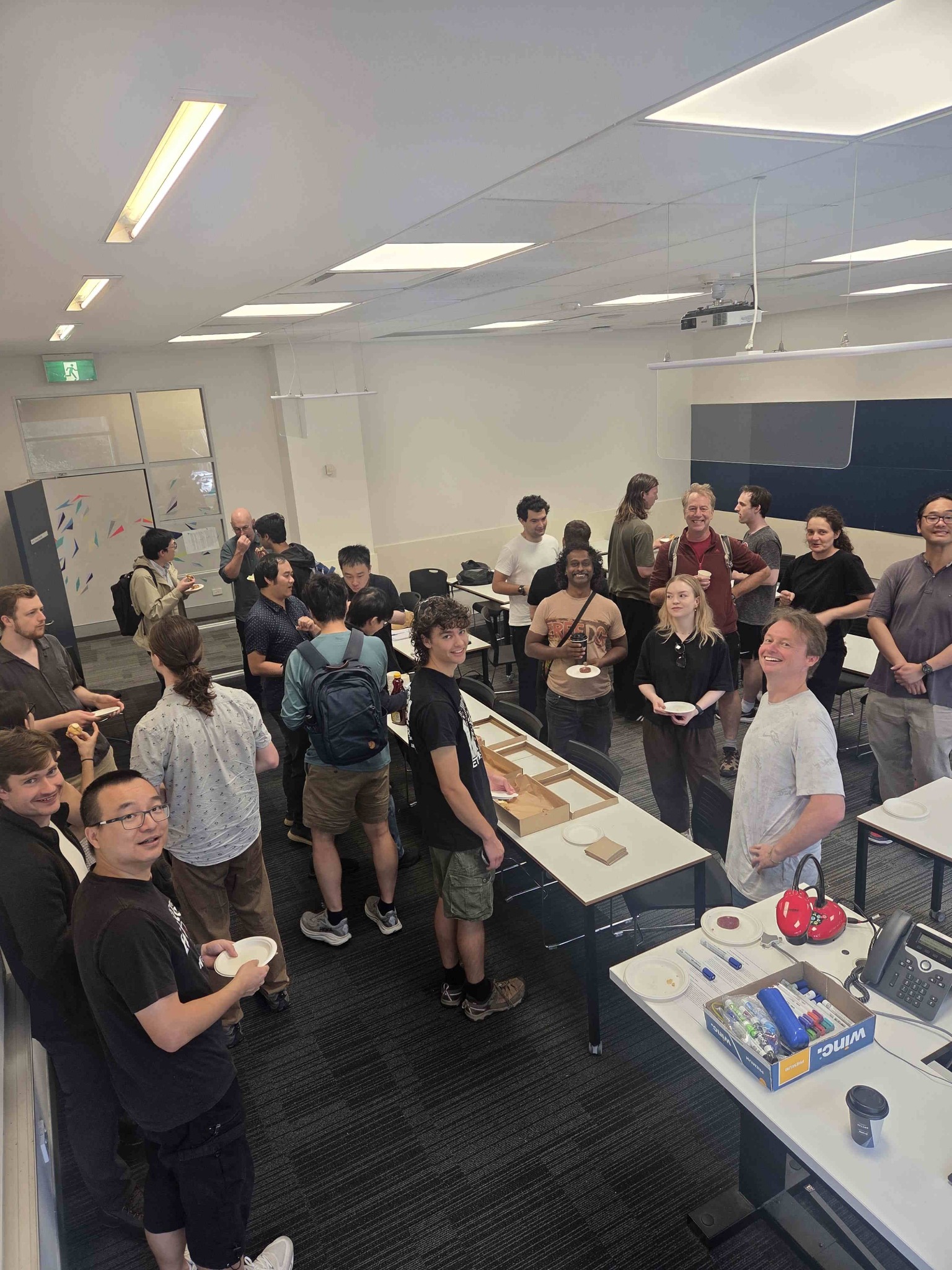
The second workshop in the Australian Geometric Analysis and PDE workshop series was held at the University of Wollongong on Friday 10 April 2026. The day brought together researchers from around Australia for talks and discussion. Speakers were Jiakun Liu (USyd), Mat Langford (ANU), Cale Rankin (UNSW Canberra), and James Stanfield (UOW). Topics ranged across complex geometry, curvature flows, optimal transport, free-boundary problems, and mathematical economics.
Venue and timetable
The workshop was held in Building 24 at UOW.
- Refreshments from 10:00am to 10:30am
- Seminar from 10:30am to 12:30pm in Room 24-101
- Lunch from 12:30pm to 1:30pm
- Seminar from 1:30pm to 2:30pm in Room 24-101
- Refreshments from 2:30pm to 3:00pm
- Seminar from 3:00pm to 4:00pm in Room 24-401
If travelling from Sydney by public transport, one option is to take the South Coast Line to North Wollongong station. From the west side of the station, the UOW shuttle is available, and the walk to campus is about 15 minutes.
Talks
James Stanfield (Wollongong), 10:30am
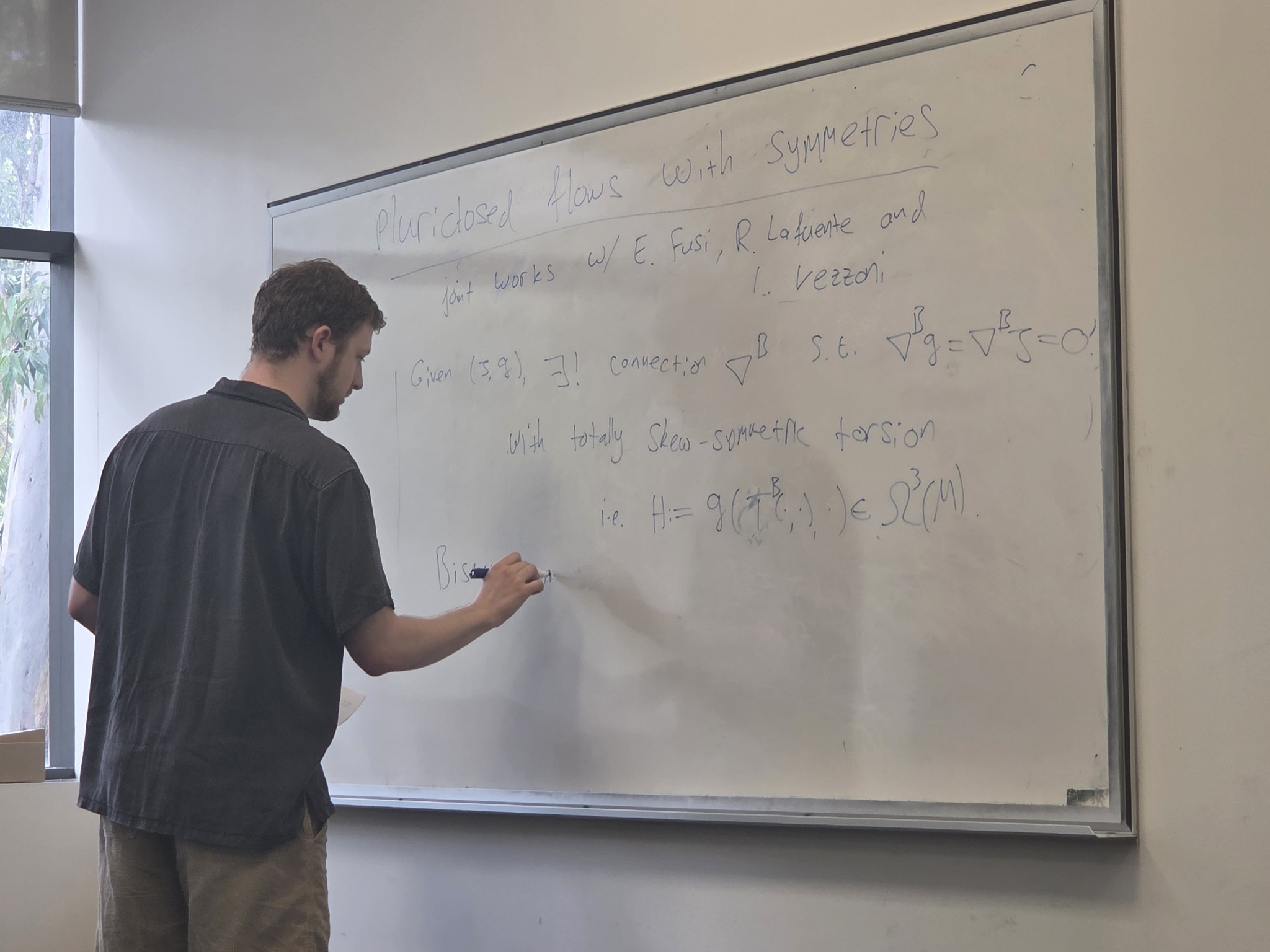
Pluriclosed flows with symmetries
The pluriclosed flow was introduced by Streets and Tian in 2010 as a generalisation of the Kähler–Ricci flow to pluriclosed metrics, a class of Hermitian metrics on complex manifolds that strictly contains the class of Kähler metrics. Pluriclosed metrics arise naturally in physics and exist on every complex surface, making the pluriclosed flow a promising tool for the classification of complex surfaces.
A fundamental open problem is to determine the maximal existence time of the pluriclosed flow. It is conjectured that this is governed by a cohomological invariant known as the Aeppli–Chern class.
In this talk, results were presented confirming this conjecture in several symmetric settings, including the general case of nilmanifolds and invariant solutions on solvmanifolds. Convergence results in the invariant setting were also discussed, arising from a new interpretation of the pluriclosed flow as a finite-dimensional gradient flow of generalised Lie brackets. This approach combines ideas from generalised geometry and real geometric invariant theory.
This is forthcoming joint work with Elia Fusi, Ramiro Lafuente, and Luigi Vezzoni.
Jiakun Liu (USyd), 11:30am
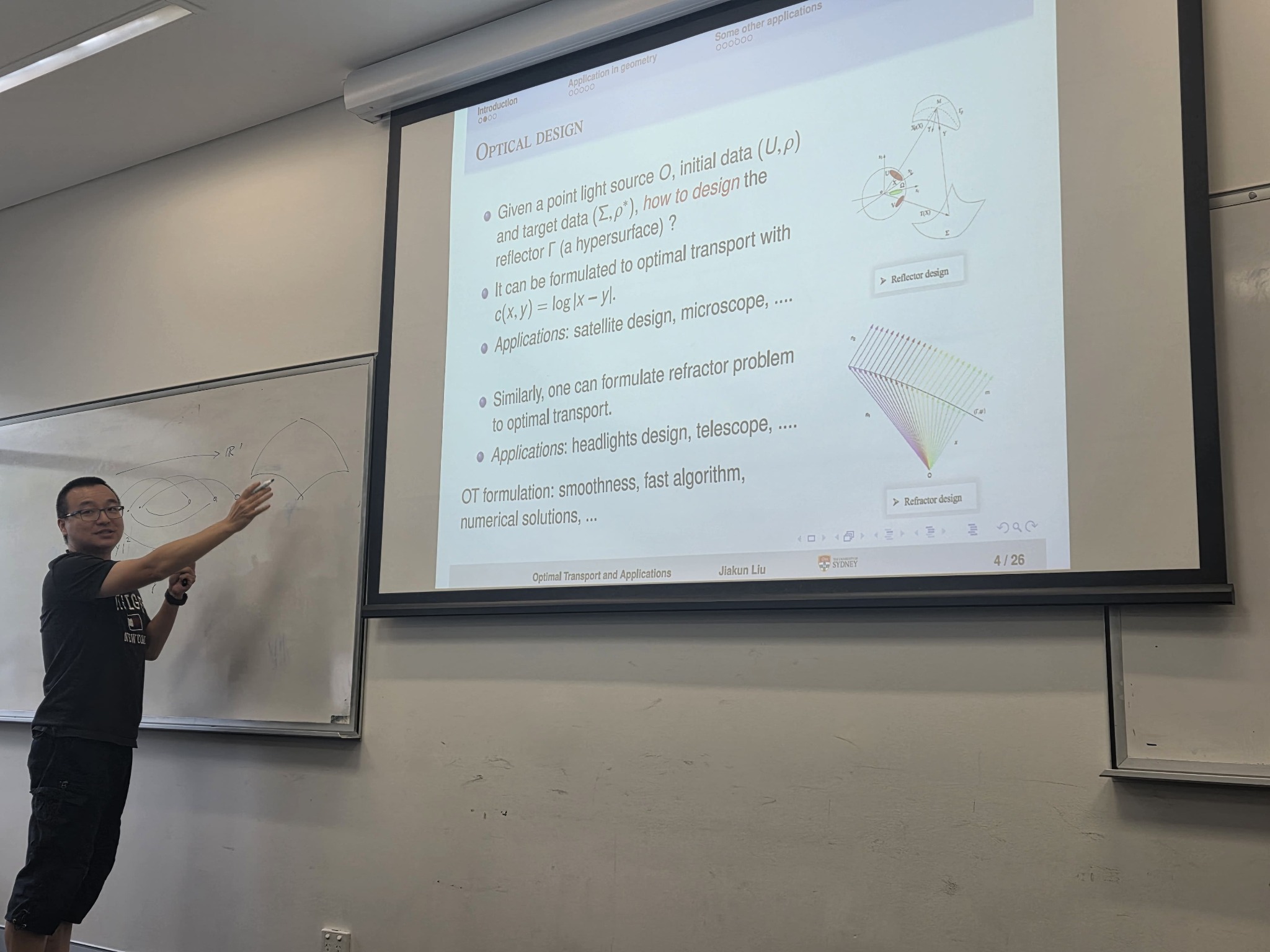
Optimal transport and some applications
This talk gave a brief introduction to the optimal transport problem and discussed applications in geometry, cosmology, and image recognition. Recent results on the free boundary problem in optimal transport were also discussed.
Mat Langford (ANU), 1:30pm
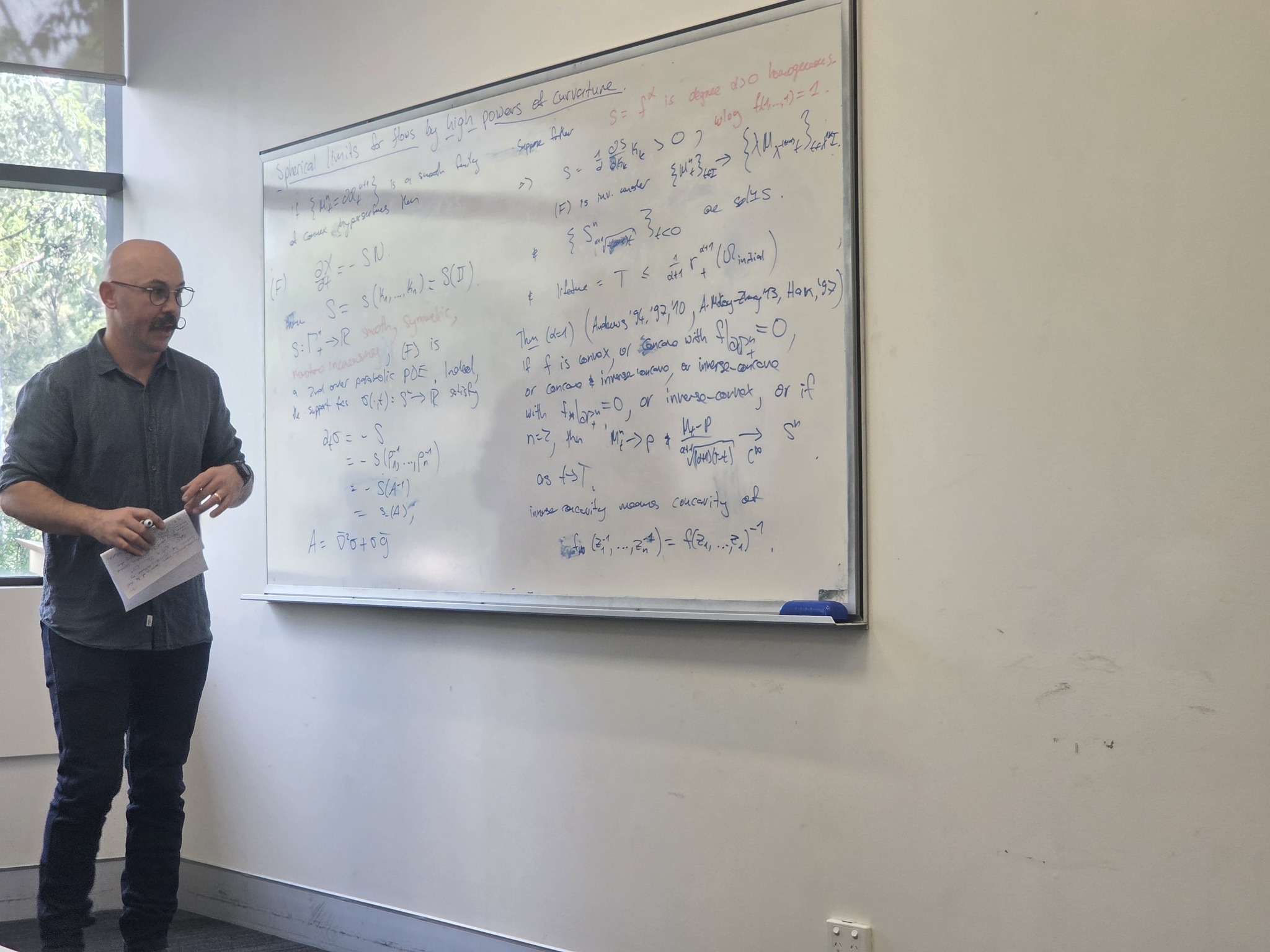
Spherical limits for a class of flows by high powers of curvature
This talk established asymptotic roundness for convex hypersurfaces evolving by geometric flows whose speeds are given by suitable powers $\alpha > 1$ of degree-one homogeneous, inverse-concave functions of the principal curvatures which do not vanish at the boundary of the positive cone. The result applies to the flow by powers $1 < \alpha \le \alpha_p$ of the $p$-th power mean when $p > 0$ (with $\alpha_p \to \infty$ as $p \to \infty$) and, remarkably, to the flow by all powers $\alpha > 1$ of the largest principal curvature. These are the first examples, outside of the Gauss curvature flows and an assortment of special examples in dimension two, where such behaviour has been observed for flows by speeds of homogeneities other than one in the principal curvatures. The proof is based on a novel estimate involving the circumscribed radius.
This is joint work with Ben Andrews and James McCoy.
Cale Rankin (UNSW Canberra), 3:00pm
On the Hausdorff dimension and singularities of the monopolist’s free boundary curve
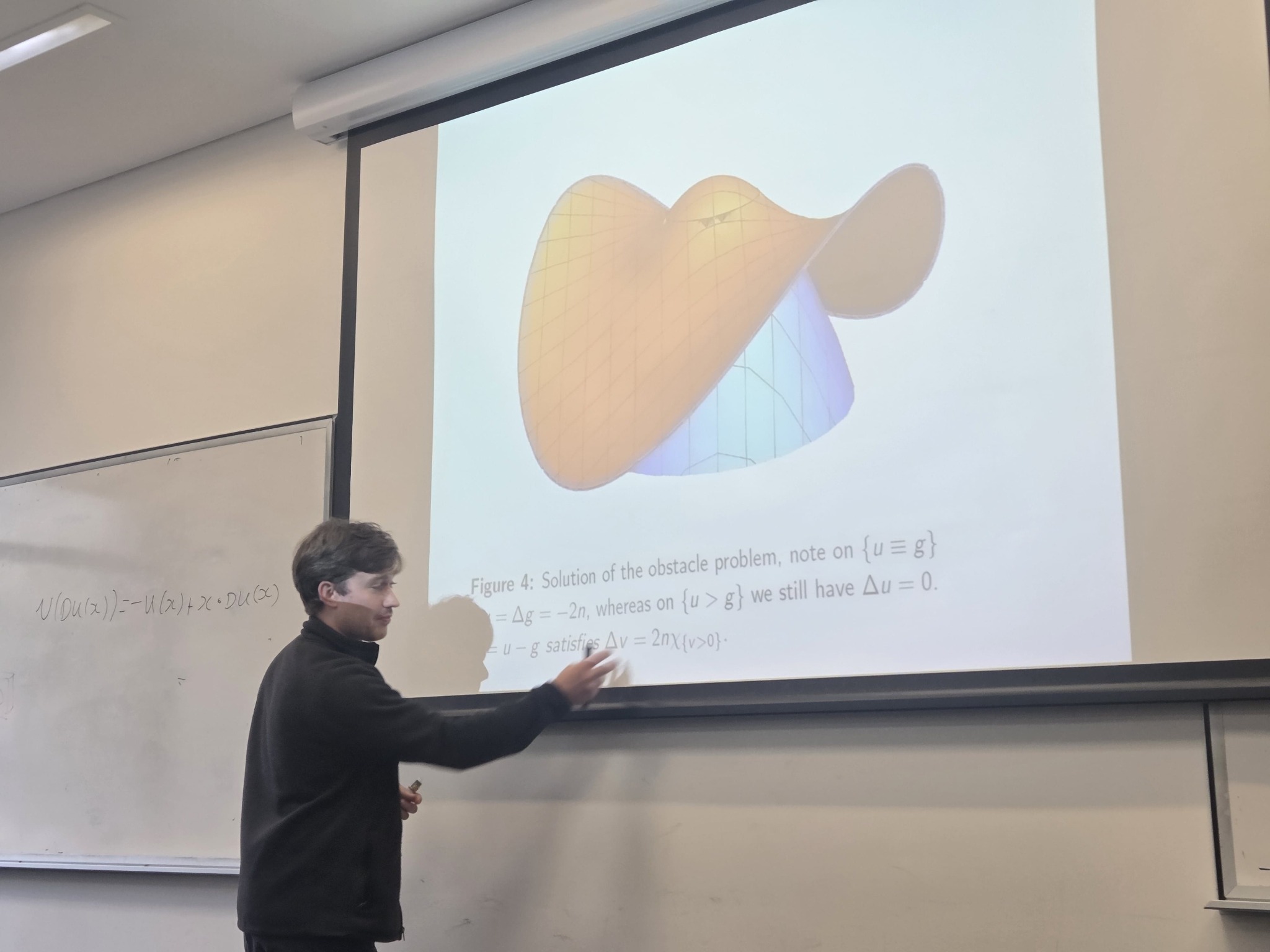
This talk discussed recent joint work with McCann and Zhang, and with McCann and O’Brien, on the monopolist’s problem. This problem comes from a simple economics model with rich mathematical structure, sitting at the intersection of optimal transport, free boundary problems, and convex analysis. Mathematically, one seeks to minimise a uniformly convex Lagrangian over the space of convex functions. The convexity constraint leads to a free boundary between regions of strict and non-strict convexity, and the solution displays qualitatively different behaviour in these regions. The talk outlined recent results on the configuration of the different domains, Hausdorff estimates for the free boundary, and the structure of solutions in several prototypical cases.
Photo links
- Group photo
- Speaker photo (10:30 talk)
- Speaker photo (11:30 talk)
- Speaker photo (1:30pm talk)
- Speaker photo (3:00pm talk)
Thanks
Many thanks to the speakers and to everyone who attended and contributed questions and discussion throughout the day. The workshop depended on strong participation and engagement, including from UOW students. Thanks also to the organisers Tim Buttsworth, Paul Bryan, and Valentina Wheeler, and to the local administrative team for their help with the many practical tasks that made the day run smoothly.